Violent crimes are behaviors usually commited by individuals or group of criminals against themselves (suicide or self-abuse) or others. Considering field investigations performed in this study, it was determined that violence is social in nature, and often occurs in interactions between people or groups of people. Violence occurs in various forms: physical, economic, political, social and cultural such as murder, hitting and hurting, terrorizing, war, threats, damaging, desecration and demeaning, insulting, obscenity and threatens individual and social security. Due to the fact that all societies today face violence, and what today’s societies are concerned with is the scope of violence, and considering that studies regarding violence and the incidence of dangerous crimes in the judicial districts in the vicinity of Tehran have not been performed (studies have mainly been concerned with domestic violence - including violence against women, children, and spouse - killing; on a national level, or specific provinces). Based on the information of this study, it can be claimed that violence has been increasing in the past few decades, especially among young people. This study maintains that by providing the means for young people’s marriages, teaching correct upbringing method to parents, correct supervision of children by their parents, implementing sound judgment, controlling anger, and providing a sound educational environment, steps can be taken toward prevention and reduction of violent crimes such as murder or fights. In this study, the concept of violent and dangerous crimes and criminals, the circumstances that help their formation, the outcome of the criminal and non-criminal measures taken, and approaches for attaining native solutions are analyzed.
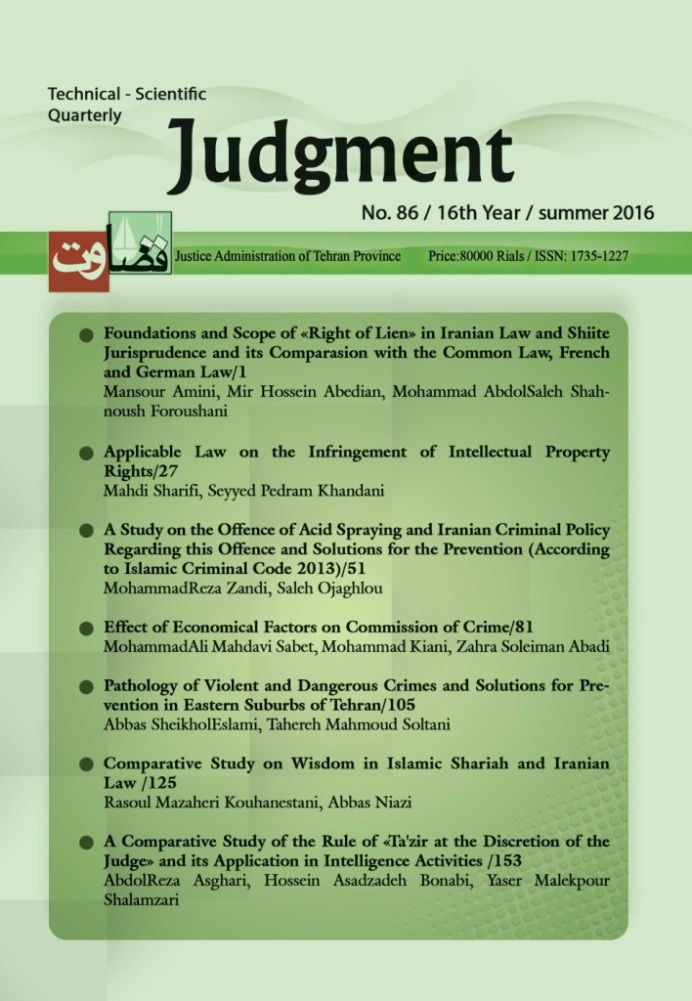
SheikholEslami,A and Mahmoud Soltani,T . (2016). Pathology of Violent and Dangerous Crimes and Solutions for Prevention in Eastern Suburbs of Tehran. Judgment, 16(86), 105-124.
MLA
SheikholEslami,A , and Mahmoud Soltani,T . "Pathology of Violent and Dangerous Crimes and Solutions for Prevention in Eastern Suburbs of Tehran", Judgment, 16, 86, 2016, 105-124.
HARVARD
SheikholEslami A, Mahmoud Soltani T. (2016). 'Pathology of Violent and Dangerous Crimes and Solutions for Prevention in Eastern Suburbs of Tehran', Judgment, 16(86), pp. 105-124.
CHICAGO
A SheikholEslami and T Mahmoud Soltani, "Pathology of Violent and Dangerous Crimes and Solutions for Prevention in Eastern Suburbs of Tehran," Judgment, 16 86 (2016): 105-124,
VANCOUVER
SheikholEslami A, Mahmoud Soltani T. Pathology of Violent and Dangerous Crimes and Solutions for Prevention in Eastern Suburbs of Tehran. Judgment. 2016;16(86):105-124 (In Persian).