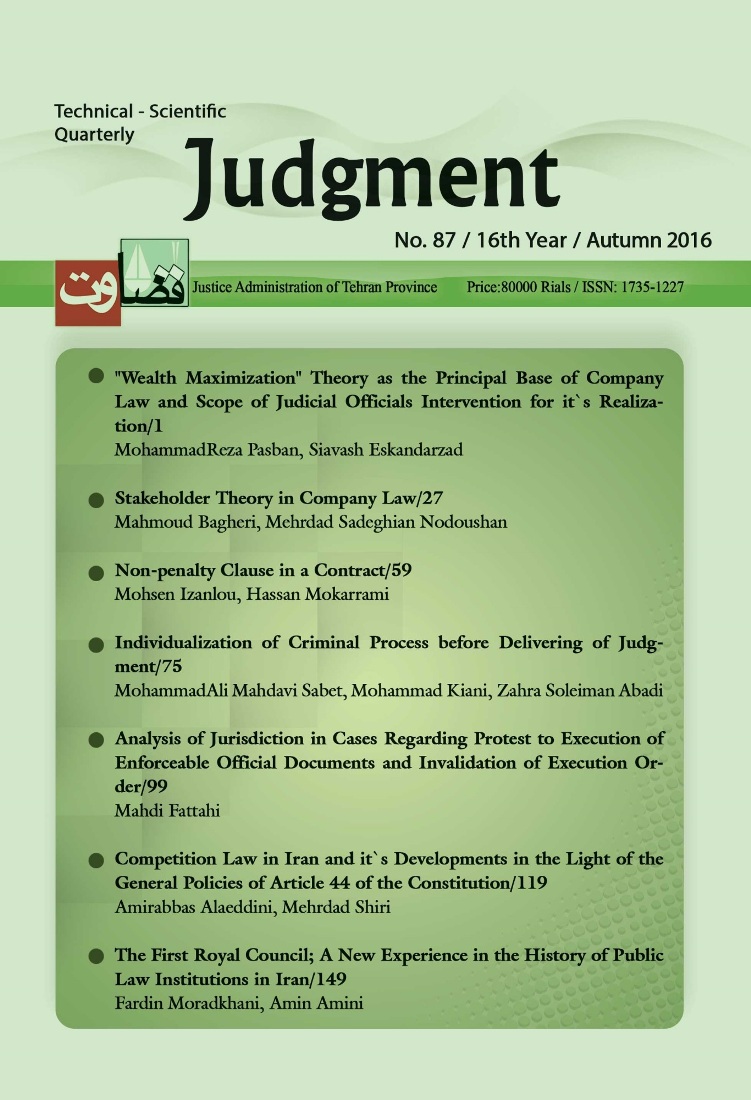
Judgment

Judgment

Analysis of the Foundations of Civil Liability of Government Employees through Examination of Legal Provisions, Legal Theories, and Judicial Rulings

Document Type : Scientific

Authors
1 PhD in private law- lecturer University, Law Department Javad Al-Aimmah University, Yazd.
2 Ph.D. Student in (Public law). maybod branch. Islamic Azad University. Maybod. Iran.
10.22034/judg.2025.2060743.1480
Abstract
Sometimes, due to the actions of an employee, damage is inflicted on another party, raising the issue of their civil liability. This article analyzes the civil liability of government employees through a descriptive-analytical method by examining legal theories and judicial rulings. The review of legal theories indicates that no single theory can serve as the sole basis for the civil liability of government employees or the responsibility of the state. When an employee, while performing their duties, causes damage to a client due to negligence, they bear civil liability. However, if the damage is related to a deficiency in the administrative tools, the responsibility for compensation lies with the administration. Furthermore, holding an employee accountable can hinder their creativity, as fear of liability may prevent them from performing their duties correctly. Solely holding the state responsible can also lead employees to work carelessly. It is essential to distinguish between damages caused by employees' negligence and those arising from administrative negligence, attributing responsibility to the party whose fault caused the loss. The state is responsible for organizational deficiencies and weaknesses in its administrative structure, while the employee is accountable for their own negligence. In cases of gross negligence and when malice is established, responsibility should rest with the employee. However, in other cases, civil liability should be determined according to legal standards. In instances of loss, according to general civil liability rules, the employee is liable unless the loss results from deficiencies in government resources or if a cause stronger than that of the direct agent is present. Additionally, in cases where specific laws apply, we refer to and act according to those laws, such as the liability of judges who are personally liable in cases of intent or gross negligence that is treated as intent; otherwise, the public treasury compensates. One potential solution is to extend this principle to employees.
Keywords

Subjects


Articles in Press, Accepted Manuscript
Available Online from 01 October 2025

  • Receive Date 22 May 2025
  • Revise Date 17 August 2025
  • Accept Date 01 October 2025